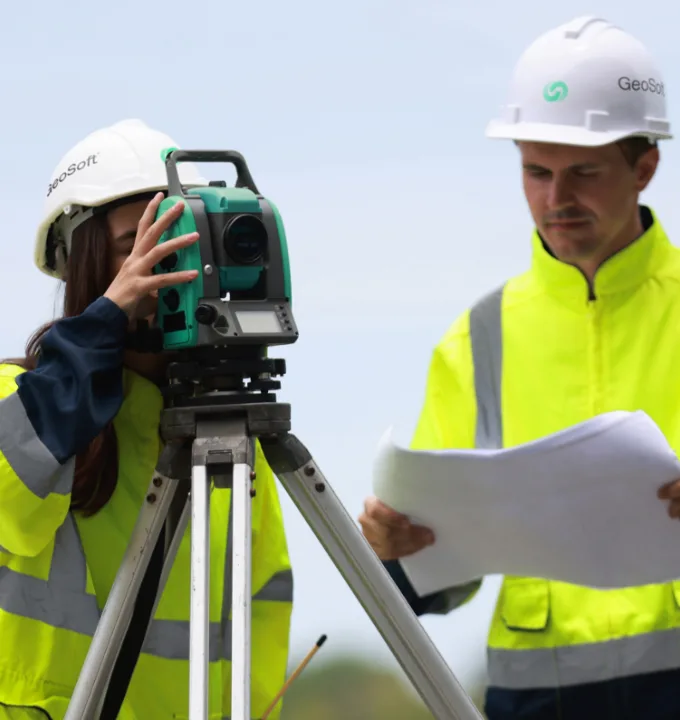
Above and Underground Utility Mapping

Geospatial services

We provide high-precision utility detection using ground-penetrating radar (GPR) and electromagnetic locators. Our comprehensive above and underground utility mapping ensures submillimeter accuracy, preventing conflicts and reducing construction risks across all project phases.

Decision-Ready Utility Intelligence

We provide comprehensive above- and below-ground utility mapping that converts hidden infrastructure risk into verified, design-ready spatial intelligence. We apply an integrated multi-sensor methodology—Ground Penetrating Radar (GPR), electromagnetic induction (EMI), terrestrial and mobile LiDAR, CCTV pipe inspection, and non-destructive vacuum excavation—to detect, locate, and document buried and overhead utility assets with survey-grade precision.

Utility strikes remain one of the most costly and avoidable failure modes in excavation, driven by incomplete as-builts, fragmented legacy records, and outdated mapping practices. Our subsurface utility engineering (SUE) and above-ground infrastructure mapping workflows mitigate this exposure by delivering classified, georeferenced utility datasets that support safer design decisions, tighter construction planning, and stronger field execution.

For complex urban environments, we complete utility surveys in days—not weeks—providing actionable subsurface intelligence exactly when design and construction teams need it to protect schedule, budget, and workforce.

How We Map the Invisible: Multi-Sensor Detection Technology

No single sensor can detect every utility type in every ground condition.
Our field methodology deploys complementary detection technologies in a coordinated workflow — ensuring maximum detection
rates across metallic and non-metallic, active and abandoned, shallow and deep-buried infrastructure.

Ground Penetrating Radar (GPR)

Non-destructive subsurface imaging using dual-frequency and multi-channel antenna arrays (250 MHz – 800 MHz) to detect both metallic and non-metallic utilities — including PVC pipes, concrete ducts, fiber optic conduits, and abandoned infrastructure invisible to electromagnetic methods. High-speed 3D GPR arrays enable full-coverage scanning of roads and rights-of-way without disrupting traffic flow.

Electromagnetic Induction (EMI)

Precision cable and pipe locating using transmitter-receiver systems that induce and trace electromagnetic signals along conductive utilities. Active and passive mode detection identifies energized power cables, metallic water and gas mains, telecommunications lines, and tracer wires on non-metallic conduits — with depth estimation accuracy of ±10–15%.

Terrestrial & Mobile LiDAR

High-definition scanning of above-ground utility infrastructure — poles, overhead lines, transformers, valve chambers, manholes, hydrants, and junction boxes. Mobile LiDAR captures entire utility corridors at highway speed, extracting pole heights, wire sag measurements, attachment points, and clearance envelopes from classified point clouds.

CCTV Pipe Inspection

Robotic camera inspection of gravity sewers, stormwater drains, and accessible conduits — documenting internal condition, pipe material, diameter, gradient, lateral connections, and structural defects. NASSCO/WRc-standard reporting provides asset condition data critical for rehabilitation planning and remaining life assessment.

What We Deliver: Actionable Utility Intelligence

Classified Utility Basemaps

Comprehensive 2D and 3D utility maps delivered in CAD (DWG/DXF), GIS (Shapefile/GeoJSON/GDB), and PDF formats. Every detected utility is attributed with type, material (where determinable), approximate depth, quality level classification, detection method, and confidence assessment — in full compliance with ASCE 38-22 documentation standards.

Subsurface Utility Engineering (SUE) Reports

Professional engineering reports documenting investigation methodology, equipment specifications, detection results, conflict analysis, and risk recommendations. SUE reports serve as the definitive record of due diligence — protecting project owners, designers, and contractors from liability associated with utility damage.

3D Utility Models & BIM Integration

Three-dimensional utility corridor models integrating detected subsurface data with above-ground infrastructure — ready for import into Revit, Civil 3D, MicroStation, and BIM 360 environments. Models support automated clash detection against proposed designs, enabling conflict resolution during design rather than during construction.

Utility Conflict Matrices

Systematic identification and documentation of every point where proposed design elements intersect, encroach upon, or conflict with existing utility infrastructure. Conflict matrices quantify risk severity, recommend resolution strategies (relocate, protect, adjust design), and enable cost-informed decision-making before construction mobilization.

Digital Utility Twins

Interactive, data-rich 3D models integrating geometric survey data with utility attribute databases, condition assessments, and maintenance records. These living digital assets support network management, capacity planning, emergency response, and predictive maintenance across the utility lifecycle.

Above-Ground Asset Inventories

Georeferenced databases of all visible utility infrastructure — poles, overhead conductors, transformers, switching gear, valve boxes, manholes, hydrants, meters, and markers — with attribute data including height, material, condition, and ownership. Delivered in GIS-ready formats for direct integration into asset management platforms.

Industries We Serve

industry image

deliver image

Oil & Gas

Pipeline Route Survey | Facility Change Detection | Methane Emission Monitoring | | Offshore Platform
Surveillance | Oil Spill Detection | SCADA-GIS Integration I AL/ML based Asset Moniroting

industry  image

industry image

AEC & Building Documentation

Scan-to-BIM Conversion | Construction Progress Monitoring | As-Built Verification | Renovation Design Support |
MEP Coordination

industry  image

deliver image

Infrastructure & Transportation

Traffic flow simulation I Urban Planning | Citizen Service Mapping | Emergency Management | Public Health
Mapping I Rail Network Monitoring | InSAR Settlement Monitoring I Digital twin Development

industry image

deliver image

Mining & Quarrying

Mineral Mapping | Open Pit Volume Monitoring | Tailings Dam Surveillance | Mining Subsidence Monitoring |
Progressive Rehabilitation Tracking | Environmental Compliance Reporting I HSE Virtual Tour

industry  image

industry image

Manufacturing & Industrial

Plant Documentation | Equipment Routing | Maintenance Planning | Digital Twins | Risk Management | VR HSE
Training

industry  image

deliver image

Utilities & Networks

Underground Mapping | Route Planning & Conflict Detection | Asset Documentation | Damage Assessment | Safety
Verification

industry image

deliver image

Coastal, Marine & Hydrographic

Shoreline Change Detection | Satellite Bathymetry | Coastal Erosion Monitoring | Marine Habitat Mapping | Flood
Inundation Modelling | Sediment Transport Analysis

industry  image

industry image

Environmental Management

Environmental Impact Assessment | Habitat Classification | Carbon Accounting | Water Quality Monitoring | Land
Degradation Assessment | Climate Change Indicators | Sustainability Reporting

industry  image

deliver image

Defense, Security & Intelligence

Force Deployment Planning | Terrain Analysis | Border Surveillance Analytics | Geospatial Intelligence (GEOINT)
And Image Intelligence (IMINT)

Our Methodology: Precision at Every Stage

A proven four-stage process ensuring accuracy, compliance, and actionable insights

deliver image

Plan with Intelligence

Before mobilizing, we begin with a data-driven understanding of your asset environment. We perform a comprehensive site intelligence review — analyzing existing drawings, access limitations, hazardous zones, operational constraints, and required accuracy levels.

deliver image

Precision Field Acquisition with real time QC

Our field teams deploy fully calibrated instruments in strict accordance with manufacturer specifications and project QA protocols. Intelligent workflows deliver real-time on-site feedback on coverage, registration integrity, and data quality

deliver image

AI-Driven Data Processing & Extraction

Curates raw data, Guides AI, Validates Output into actionable digital intelligence through a hybrid pipeline of advanced algorithms, machine learning models, and expert review.

deliver image

Decision-Ready Deliverables

Outputs are not merely models but enterprise-ready information assets. All datasets undergo independent quality assurance audits. We ensure your organization can immediately operationalize the data for planning, maintenance, and strategic decision-making.

Case Studies

We’re building a greener tomorrow. Our solutions optimize operations, cut waste, and lower emissions, supporting net-zero goals. Internally, we use renewable energy, reduce travel with digital tools, and partner with eco-conscious suppliers.

Geospatial services

Precision Geodetic Monitoring

Millimeter-accurate subsidence monitoring across 35 offshore platforms using advanced GNSS technology and international reference frames. Our exacting survey approach achieved sub-centimeter precision over 100km baselines…

±3mm
Positioning Accuracy
35
Platforms Monitored
100km
Baseline Precision
Geospatial services

Geospatial Mapping

Revolutionizing large-scale topographic mapping with advanced mobile LiDAR technology. Our rapid deployment solution captured 19 million square meters of complex terrain in record time, delivering…

4 Weeks
Project Completion
80%
Data Accuracy
100%
Data Accuracy
Geospatial services

Utility Mapping & Detection

Eliminating subsurface uncertainty with advanced ground penetration radar and electromagnetic detection technologies. Our comprehensive 3D utility mapping provides complete visibility of underground infrastructure

Zero
Utility Strikes
95%
Detection Accuracy
100%
Project Compliance

Why Organizations Choose Our Utility Mapping Services

Technical Excellence

Industry-leading accuracy specifications (±1–2 mm TLS, ±2–5 cm aerial) backed by systematic, documented QA/QC processes ensuring reliable, repeatable results across diverse project types — from offshore platforms in extreme marine environments to sensitive heritage interiors.

Operational Efficiency

Multi-platform deployment and AI-accelerated processing compress project timelines by up to 70%. What once required months of manual survey and CAD drafting now delivers registered, classified point clouds and intelligent models in days to weeks.

Integrated Solutions

Complete service delivery from project planning and field acquisition through processing, modeling, and specialized analysis — all under one roof. No fragmented vendor chains, no data conversion losses, no accountability gaps.

Integrated Solutions

Complete service delivery from project planning and field acquisition through processing, modeling, and specialized analysis — all under one roof. No fragmented vendor chains, no data conversion losses, no accountability gaps.

Proven ROI

Our clients consistently document measurable returns: 30–50% reduction in field rework, 20–40% faster project delivery, elimination of fabrication mismatches, and extended asset service life through predictive condition monitoring.

The Spatial Intelligence Advantage

The geospatial industry is undergoing a fundamental transformation. AI-powered point cloud classification, real-time SLAM navigation, and cloud-based digital twin platforms are converging to make reality capture faster, more accessible, and more valuable than ever before.

Contact Our Specialist

Get in touch to discuss comprehensive terrestrial and aerial laser scanning addressing your project requirements.


Global Operations
24/7 support across multiple time zones