How We Investigate the Ground
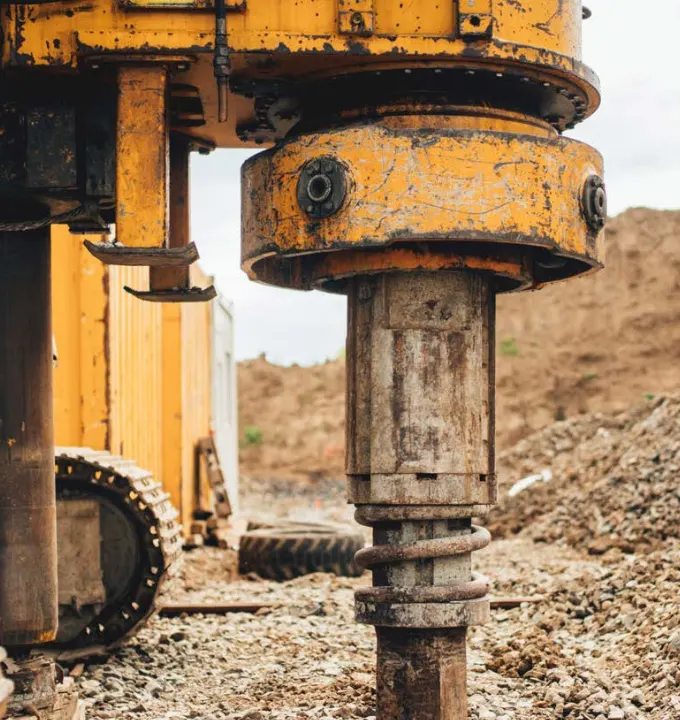
Geotechnical Drilling
Our approach combines rotary core drilling and percussion/auger drilling to obtain high-quality data essential for design and analysis.
Through diamond-bit rotary core drilling, we recover continuous core samples from soil and rock formations,
allowing for precise lithological logging, discontinuity mapping, and detailed laboratory testing.
In softer overburden soils, we utilize cable percussion (shell and auger) and hollow-stem auger
drilling methods for rapid borehole advancement.
In-Situ Testing Techniques
We conduct comprehensive in-situ testing to evaluate soil behavior and engineering properties
directly within the ground. Our methods include Cone Penetration Testing (CPT/CPTu) and Standard
Penetration Testing (SPT), both providing valuable data for geotechnical design and analysis.
All CPT and SPT results are energy-corrected (N₆₀) and normalized for overburden pressure ((N₁)₆₀) in accordance with
ASTM D1586 and BS EN ISO 22476-3 standards.
Geophysical Ground Profiling
Non-invasive subsurface imaging using seismic refraction/MASW, electrical resistivity tomography (ERT),
and ground penetrating radar (GPR) — providing continuous 2D and 3D ground profiles between boreholes.
Geophysics bridges the gap between discrete borehole data points, identifying lateral variability,
buried structures, voids, and groundwater interfaces across the full site footprint.
Accredited Laboratory Testing
Every soil and rock sample undergoes systematic laboratory testing in our accredited facilities — delivering
the engineering parameters your designers need with full traceability,
repeatability, and compliance with international standards.
All laboratory testing complies with BS 1377, ASTM D-series, BS EN ISO 17892,
and AASHTO standards.