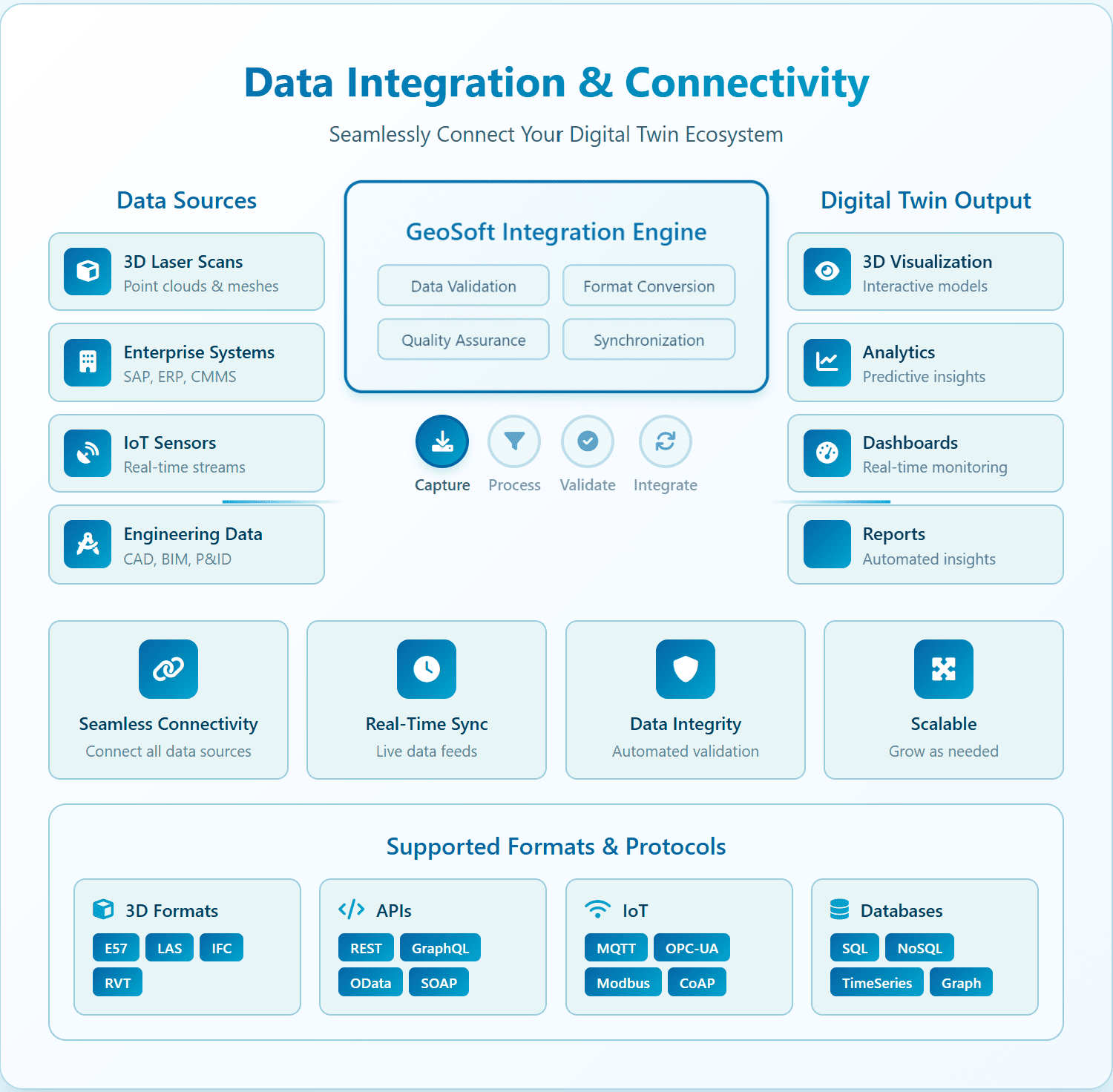
How We Connect Your Data
Geospatial Normalisation
All incoming datasets — point clouds, bathymetry, sub-bottom profiles, utility maps, drone surveys, satellite imagery, CAD, BIM, and tabular records — are transformed into a common spatial reference framework, unifying land, coastal, marine, and subsurface data into consistent projections and vertical datums. Legacy drawings, survey control networks, and GNSS-based datasets are resolved into a single, traceable geodetic model, with full metadata and transformation logs maintained so every coordinate decision remains auditable years into the future.
Multi Source Data Fusion
TLS, SLAM, mobile LiDAR, aerial LiDAR, and photogrammetric datasets are merged into unified point cloud and surface models, while hydrographic and geophysical products — multibeam bathymetry, sidescan sonar, UXO anomalies, and ground models — are integrated seamlessly with terrestrial topography and underground utility mapping. BIM objects and CAD entities are linked directly to geospatial features, asset IDs, and maintenance records, creating a single, connected environment where every dataset reinforces the next.
Enterprise System Connectivity & APIs
Connect sits between your technical datasets and enterprise platforms, ensuring data flows directly to where decisions are made. Bidirectional integration with GIS, asset management, EAM, maintenance, ERP, and document management systems keeps every platform current and consistent, while open APIs and data services expose live geospatial layers and 3D models to planning tools, digital twins, web portals, and analytics dashboards in real time.
Real Time Data Streams
Static survey data captures a moment — Connect captures the continuum. Live IoT sensor networks, structural monitors, environmental sensors, and process instrumentation are ingested with full geospatial context, while subsea monitoring feeds, touchdown data, remote ROV video, USV/AUV tracks, and construction telemetry stream directly into the same platform used for design and planning. Time-enabled layers allow users to scroll through the complete spatial and operational history of any asset