

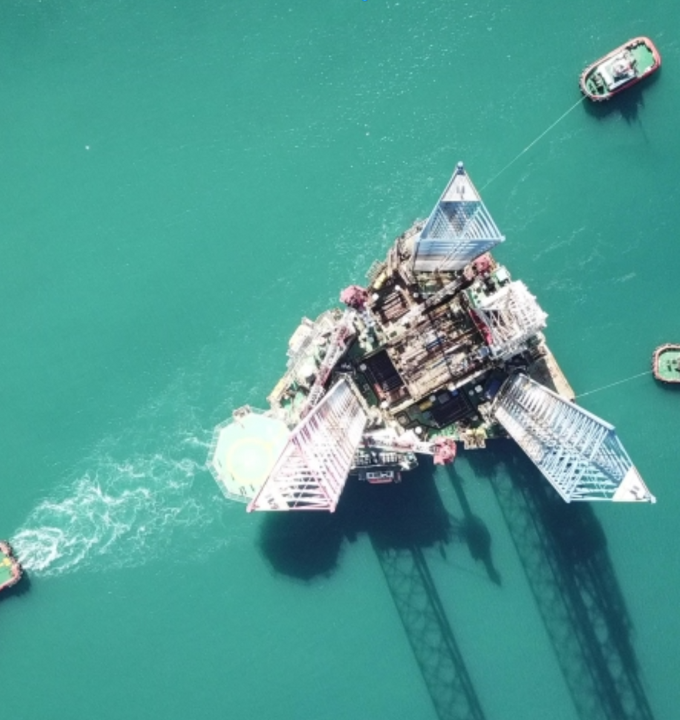
How we Position Rigs
Multi-GNSS Absolute Positioning
Every rig move begins with a survey-grade absolute positioning framework. We deploy multi-constellation GNSS receivers operating on RTK or differential corrections — giving continuous, centimetric-accuracy positions for the rig, anchor-handling vessels, and support fleet throughout the entire operation. This isn’t navigation-grade GPS. It’s a controlled, auditable positioning environment that ties every observation to a project-specific geodetic datum, supports regulatory reporting, and underpins every clearance decision made during the move window.
Relative Positioning for Close-Approach
Absolute coordinates alone don’t keep a jack-up leg clear of a subsea manifold at 8-metre clearance. As the rig enters the close-approach zone, we augment GNSS with robotic total stations, reflective prisms, and relative positioning systems to monitor real-time offset, heading, and clearance geometry against existing platforms, structures, and seabed infrastructure. This hybrid approach gives the Tow Master and marine representative the spatial resolution they need to make split-second decisions in congested fields where tolerances are measured in metres, not tens of metres.
Pre-Move Dimensional Control
Before a rig moves, everything that can go wrong has to be found on paper — not on location. We carry out full dimensional control surveys of the rig and all fixed reference structures, establishing prisms and datum points that tie into a single common reference frame shared across the operation. This dimensional dataset is then integrated with hydrographic and geophysical pre-drill survey data to validate that leg footprints, anchor patterns, and mooring radii, debris fields, and infrastructure conflicts before the rig ever leaves its previous location.
Real-Time Move Monitoring
Once the move is underway, our team provides live situational displays to the Tow Master, marine representative, and bridge teams — tracking rig position, heading, speed over ground, tug vectors, and approach corridor compliance against the approved move plan in real time. During jack-up preloading, semi-sub anchor deployment, and FPSO hook-up, we maintain continuous monitoring of rig position and mooring geometry. Any deviation from the engineered layout is flagged immediately, so corrective action is taken before exposure becomes consequence.


















 Doha, Qatar
 GMT-3
GMT-3
