

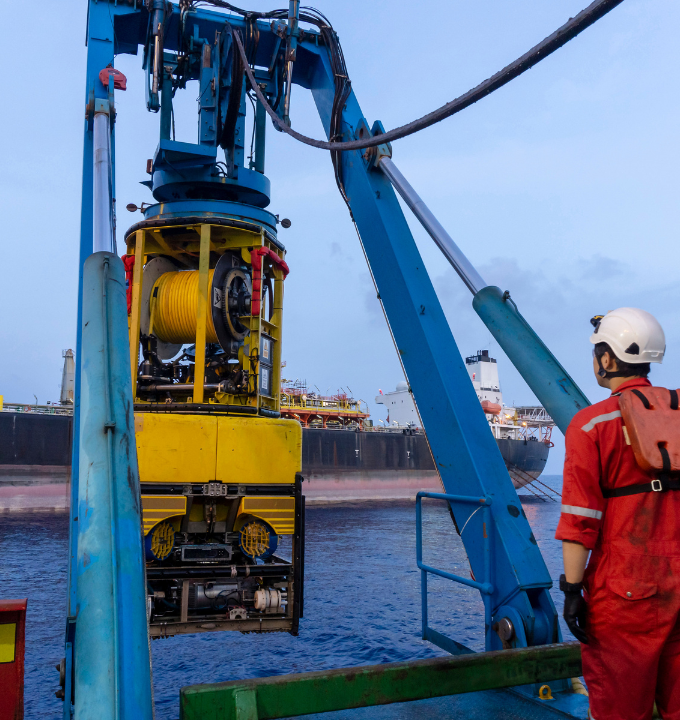
How We Execute ROV Surveys & Intervention
Multi Class ROV Fleet Matched to the Task
Observation, inspection, and work class ROVs are selected based on water depth, current regime, standoff requirements, and tooling needs—from shallow harbour inspections to deepwater IMR (Inspection, Maintenance & Repair) campaigns. Systems are configured with the appropriate thruster power, payload, and redundancy to maintain stable station in challenging conditions while carrying the required sensor and tool packages.
Integrated Sensor Suites for Quantified Inspection
Each ROV spread is equipped with application specific payloads such as HD and 4K video, stills cameras, multibeam and imaging sonar, CP probes, UT/WT thickness gauges, laser scaling, cleaning tools, and manipulators. All data streams are time synchronised with navigation so every observation can be located and revisited precisely, turning qualitative video into quantitative integrity evidence.
Survey Grade Navigation & Positioning
Acoustic positioning (USBL/LBL), inertial navigation, and Doppler velocity logs are integrated to deliver reliable subsea positioning tied to surface control networks and project datums. This allows pipelines, risers, foundations, hulls, and seabed features to be mapped and inspected within a geospatial framework that supports GIS, digital twin, and engineering model integration.
Remote & Resident Operations
Where project geometry and infrastructure allow, ROVs may be operated from onshore control centres or resident subsea garages, reducing vessel days and improving availability around the clock. Supervised autonomy, advanced control systems, and highbandwidth communications enable extended campaigns with fewer offshore personnel while maintaining full human oversight of critical tasks.













 Doha, Qatar
 GMT-3
GMT-3
