

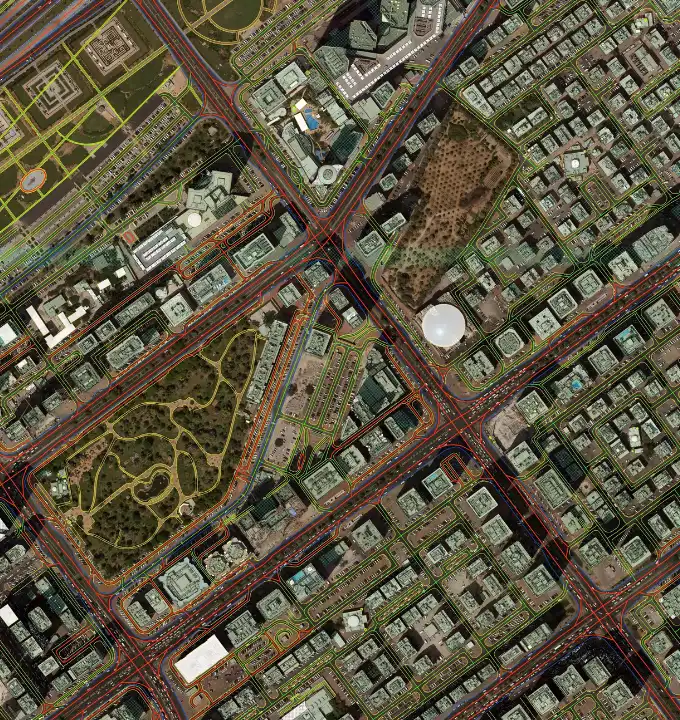
How We Capture Earth Intelligence
Multi-Sensor Satellite Earth Intelligence
Multi-sensor satellite technology is used to capture high-fidelity Earth intelligence by matching
the right sensor to the right application, from engineering design to environmental monitoring.
Integrated workflows fuse very-high-resolution optical, multispectral, and hyperspectral satellite
data into a single geospatial environment, maximizing information extraction, classification accuracy,
and decision-ready insight for infrastructure, energy, environmental, and government clients.
Very-High-Resolution Optical Satellite Imagery
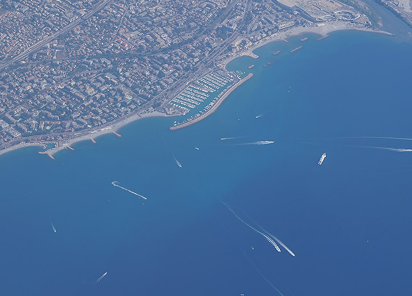
Very-high-resolution (VHR) optical satellite imagery delivers panchromatic and pansharpened products at approximately 25–30 cm ground sample distance (GSD), enabling feature-level mapping of buildings, roads, assets, and critical infrastructure. Modern constellations provide us 6–8 multispectral bands (from deep blue through near‑infrared), supporting robust feature extraction, land‑cover classification, vegetation and change indices, and wide-area topographic mapping.
Multispectral Satellite Imagery for Monitoring Change
Medium-resolution multispectral satellite platforms such as Sentinel-2, Landsat-9, and PlanetScope
provide systematic global coverage with revisit intervals typically ranging from daily to every 16 days.
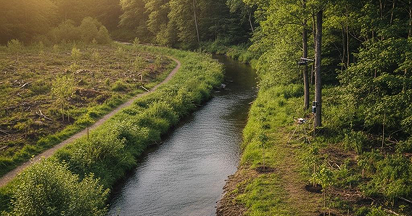
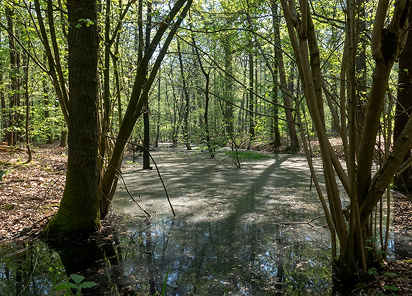
These sensors are ideal for time-series analysis of vegetation health, land use and land cover change,
water quality, coastal dynamics, and environmental compliance reporting over large areas at optimized cost.
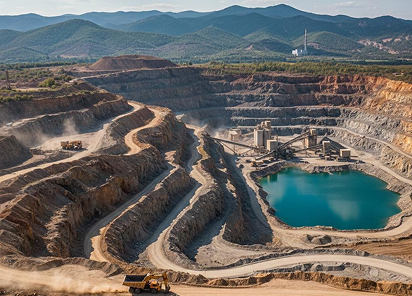
Hyperspectral Satellite Imaging for Material Intelligence
Hyperspectral satellite sensors capture data across more than 200 contiguous, narrow spectral bands,
typically with bandwidths in the 5–10 nm range, enabling material-level discrimination well beyond
traditional broadband multispectral imagery. By integrating hyperspectral outputs into advanced geospatial analytics,
we gain actionable “material intelligence” to reduce exploration risk, target interventions,
and meet stringent environmental and ESG reporting requirements.















 Doha, Qatar
 GMT-3
GMT-3
