- Introduction
The management of physical infrastructure has entered a period of fundamental transformation. Aging assets, constrained capital budgets, climate-induced risks, and an accelerating demand for data-driven governance have converged to challenge traditional siloed approaches to asset management and engineering. In this environment, Geographic Information Systems (GIS) have emerged not merely as mapping tools but as operational intelligence platforms capable of bridging the gap between the physical world and the decision-making structures that govern it.
Historically, asset management and engineering management have operated as parallel but disconnected disciplines. Asset managers concerned themselves with the inventory, condition assessment, maintenance scheduling, and lifecycle costing of infrastructure components. Engineering managers, by contrast, focused on project design, construction delivery, resource allocation, and technical compliance. The spatial dimension — the where, the proximity, the connectivity — was frequently treated as ancillary to both functions.
GIS dissolves this separation. When deployed strategically, GIS becomes the common operating picture that unites asset registries with engineering workflows, lifecycle cost models with spatial risk surfaces, field inspection data with design-phase decisions. This article explores the theoretical foundations, practical architectures, and organizational implications of that unification. Geospatial Survey Services & 3D Modeling | Geosoft Global
- GIS for Infrastructure Asset Management
2.1 The Dual Nature of Infrastructure Data
Infrastructure data is inherently bifurcated: it is simultaneously attributive (describing the characteristics of objects — material, age, condition, capacity) and spatial (describing where those objects exist relative to other objects, environments, and hazards). Conventional enterprise asset management (EAM) systems and computer-aided design (CAD) platforms have excelled at each dimension independently, but have struggled to integrate them.
GIS provides the ontological bridge. By associating every asset and every engineering feature with a geospatial coordinate system, GIS enables queries that neither pure database systems nor pure CAD environments can answer: Which assets lie within the flood inundation boundary projected under a 1-in-100-year return period? Which pipelines are within 50 meters of a proposed excavation zone? Which bridges show compounding risk factors — age, traffic loading, and proximity to seismic fault lines — that should trigger priority capital allocation?
These are not cartographic questions. They are management and engineering questions whose answers require spatial reasoning at scale.
2.2 Theoretical Alignment with Asset Management Standards
The ISO 55000 series ISO – International Organization for Standardization — the international standard for asset management — defines asset management as the “coordinated activity of an organization to realize value from assets.” Value realization requires understanding assets in context: their interdependencies, their exposure to external forces, their contribution to service delivery. GIS operationalizes that contextual understanding by making spatial relationships computable and actionable.
Similarly, the Institute of Asset Management’s (IAM) Conceptual Model identifies spatial analysis as a critical input to risk-based maintenance planning, investment prioritization, and resilience assessment. GIS is not an optional augmentation to ISO 55000-compliant asset management — it is increasingly the computational substrate through which compliance is achieved.
2.3 Engineering Management as a Spatially Mediated Process
Engineering management, as defined by the American Society of Civil Engineers (ASCE) and the Engineering Management Institute (EMI), encompasses the planning, organizing, directing, and controlling of engineering activities to achieve organizational goals. Each of these functions has a spatial dimension that is frequently underexploited:
- Planning: Site selection, corridor routing, network optimization, and environmental impact assessment are inherently spatial problems.
- Organizing: Resource deployment, crew routing, equipment staging, and subcontractor coordination depend on spatial proximity and accessibility.
- Directing: Real-time situational awareness during construction or emergency response requires spatial visualization of status, progress, and risk.
- Controlling: Quality assurance, compliance monitoring, and as-built verification benefit enormously from spatial comparison between design intent and field reality.
GIS platforms — particularly when augmented with real-time data feeds, mobile field applications, and cloud-based collaboration — enable engineering managers to exercise these functions with a level of spatial fidelity previously unavailable.
- Architecture of an Integrated GIS Platform
3.1 Core Components
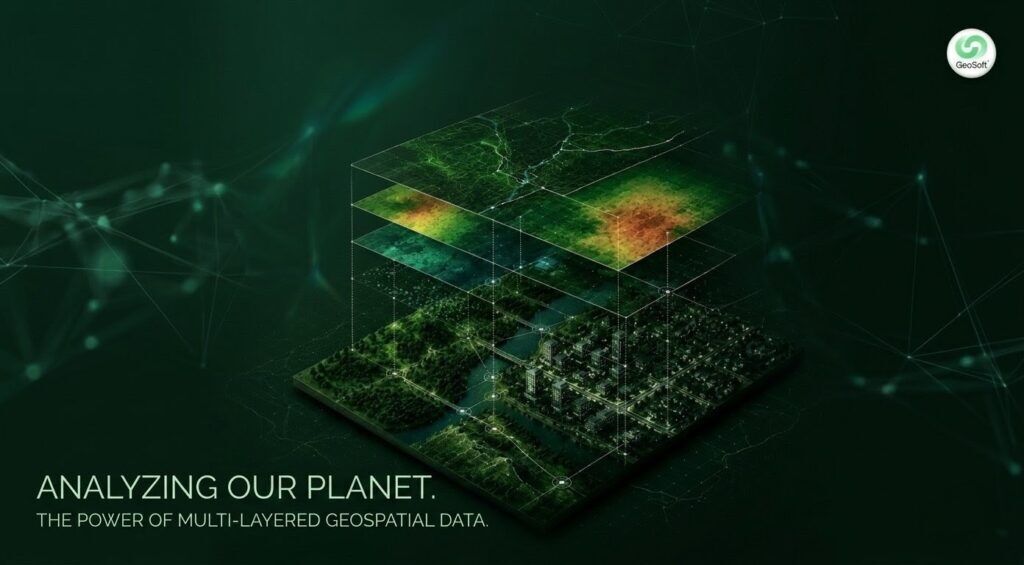
An enterprise GIS architecture designed to support both asset and engineering management functions typically comprises five interdependent layers:
Layer 1 — Spatial Data Foundation The base layer consists of authoritative spatial datasets: cadastral boundaries, topographic data, utility networks, transportation infrastructure, hydrological features, and environmental overlays. This layer is maintained by the organization’s GIS administrators in coordination with national mapping agencies and utility data custodians. Accuracy, currency, and interoperability with national standards (e.g., FGDC, ISO 19115) are paramount.
Layer 2 — Asset Registry Integration The asset registry layer connects the spatial data foundation to enterprise asset management systems (IBM Maximo, SAP PM, Infor EAM, Esri ArcGIS for Maintenance). Every asset — pipe segment, bridge deck, electrical cabinet, pump station — is represented as a georeferenced feature with attributes drawn from the EAM system. This layer enables spatial queries against the full asset database without requiring duplication of data.
Layer 3 — Engineering Workflow Integration The engineering workflow layer integrates GIS with design and project management environments. BIM (Building Information Modeling) models are georeferenced and linked to the spatial data foundation. CAD drawings are spatially referenced. Project schedules (from Primavera P6, MS Project, or equivalent) are linked to spatial work zones. This layer transforms engineering deliverables from static documents into spatially aware, queryable objects.
Layer 4 — Analytics and Decision Support The analytics layer applies spatial and statistical algorithms to the data held in Layers 1–3. This includes network analysis (e.g., valve isolation modeling, emergency access routing), risk surface generation (combining asset condition, consequence of failure, and environmental exposure), predictive maintenance modeling, and capital investment prioritization. Modern platforms increasingly deploy machine learning models — particularly for condition prediction from LiDAR, drone imagery, or IoT sensor streams — within this layer.
Layer 5 — Visualization and Dissemination The outermost layer encompasses dashboards, web maps, mobile applications, and operational displays that make spatial intelligence accessible to diverse organizational audiences: field crews, project managers, asset managers, executives, regulators, and the public. The shift toward web-based GIS portals (Esri ArcGIS Online, QGIS Web Client, Google Maps Platform for Enterprise) has democratized spatial intelligence beyond the GIS specialist community.
3.2 Integration Architecture Patterns
Three primary integration patterns govern how GIS connects with enterprise systems:
Pattern A — Federated Integration: GIS serves as a visualization and query layer over data that remains authoritative in source systems (EAM, project management, SCADA). This pattern minimizes data duplication but requires robust API connectivity and data governance protocols.
Pattern B — GIS-as-System-of-Record: GIS becomes the primary repository for spatial and network data, with other systems consuming GIS data via web services. This pattern is increasingly common for utility network management, where GIS platforms (notably Esri ArcGIS Utility Network) provide the authoritative network model.
Pattern C — Bidirectional Synchronization: Data flows bidirectionally between GIS and enterprise systems, with defined synchronization rules governing update propagation. This pattern is most appropriate for organizations with mature data governance and high data currency requirements.
- GIS in Asset Management: Key Application Domains
4.1 Asset Inventory and Condition Assessment
The foundational application of GIS in asset management is the creation and maintenance of a spatially accurate, attribute-rich asset register. Beyond simple inventory, GIS enables condition assessment programs to be designed spatially — prioritizing inspection routes by asset density, consequence of failure, or accessibility — and to produce condition data that is immediately geo-referenced for analysis.
Mobile GIS applications have transformed field condition assessment. Inspectors equipped with tablet devices and offline-capable GIS applications can record condition ratings, attach photographs, and capture GPS coordinates in real time, eliminating the manual digitization step that historically introduced errors and delays. Studies of municipal road management programs (e.g., Pavement Condition Index surveys) have demonstrated 40–60% reductions in data collection cycle time following mobile GIS adoption (Gharaibeh et al., 2021).
4.2 Risk-Based Maintenance Planning
GIS enables the spatial overlay of asset condition data with consequence models — combining the probability of asset failure with the downstream consequences (service disruption, environmental impact, public safety risk, financial liability) to produce spatially distributed risk surfaces. These risk surfaces become the foundation for risk-based maintenance planning, directing maintenance resources toward the assets and zones where intervention yields the greatest reduction in expected losses.
The Water Research Foundation’s Asset Management for Water Systems framework explicitly recommends GIS-based risk mapping as a core component of water utility asset management programs. Similar recommendations appear in ASCE’s Infrastructure Report Card and the Federal Highway Administration’s asset management guidance documents.
4.3 Capital Investment Prioritization
Long-range capital improvement programs (CIPs) benefit substantially from spatial analysis. GIS enables organizations to identify asset clusters approaching end-of-life simultaneously, plan renewal programs that achieve economies of scale through geographic concentration, coordinate capital works with planned land development or transportation improvements, and model the spatial distribution of service levels under alternative investment scenarios.
The City of Melbourne’s long-term infrastructure investment program — a widely cited example of GIS-enabled capital planning — uses spatial analytics to identify optimal renewal sequencing across drainage, road, and utility assets, reportedly achieving 15–20% capital cost savings through coordination efficiencies (City of Melbourne Infrastructure Division, 2023).
4.4 Resilience and Climate Adaptation
Climate change introduces spatially heterogeneous risks to infrastructure — flood exposure, coastal erosion, wildfire proximity, subsidence — that vary dramatically across an organization’s asset portfolio. GIS is the only tool capable of systematically mapping these exposures against the full asset inventory at the resolution required for meaningful risk assessment.
Infrastructure resilience frameworks, including those published by the United Nations Office for Disaster Risk Reduction (UNDRR) and the Intergovernmental Panel on Climate Change (IPCC), identify spatially explicit risk assessment as a prerequisite for effective adaptation investment. GIS-based climate risk screening tools are now standard components of international development institution (World Bank, Asian Development Bank) infrastructure financing due diligence processes.
- GIS in Engineering Management: Key Application Domains
5.1 Site Investigation and Feasibility Analysis
Before a single design drawing is produced, engineering managers use GIS to conduct spatial feasibility analysis: evaluating site constraints (topography, geology, hydrology, environmental sensitivity), assessing alternative alignments or footprints, quantifying earthwork volumes, and identifying conflicts with existing infrastructure. The integration of LiDAR-derived digital terrain models with GIS has dramatically accelerated this phase, enabling detailed terrain analysis at regional scales that previously required months of field survey.
5.2 Construction Project Management
GIS-enabled construction management platforms provide project managers with spatial situational awareness across large or geographically distributed work programs. Spatial dashboards can display schedule performance by work zone, track equipment utilization across sites, monitor environmental compliance zones, and support earned value analysis disaggregated by geography — revealing spatial patterns in cost and schedule variance that tabular reporting obscures.
The integration of GIS with construction management systems (Procore, Autodesk Construction Cloud, Oracle Primavera) is an active development frontier. Early adopters in linear infrastructure delivery — road, rail, pipeline — report significant improvements in subcontractor coordination and interface management through spatial scheduling tools (Turner & Townsend Infrastructure Report, 2024).
5.3 Environmental and Regulatory Compliance
Environmental permitting and regulatory compliance have strong spatial dimensions. GIS enables engineering teams to delineate environmental buffers, map permit condition constraints against work program geography, track environmental monitoring data spatially, and produce audit-ready compliance maps. In jurisdictions where digital spatial deliverables are increasingly required by regulators (a growing trend in Australia, the UK, and parts of the United States), GIS-competent engineering management teams hold a significant competitive advantage.
5.4 Stakeholder Engagement and Community Communication
GIS-based public engagement platforms — interactive web maps that allow community members to explore project extents, view construction staging plans, and submit spatially tagged feedback — have become important tools for engineering project communication. Research in public participation literature consistently finds that spatial visualization improves public comprehension of infrastructure proposals, reduces opposition grounded in misunderstanding, and increases the quality of community feedback received (Innes & Booher, 2016).
- The Convergence Case: Where Asset and Engineering Management Meet in GIS
The most significant argument for a unified GIS platform across asset and engineering management is the elimination of the handoff problem. In organizations without integrated GIS, critical spatial knowledge is lost at each organizational boundary:
- Design engineers produce as-built drawings that are not integrated into the asset register.
- Asset managers plan renewal programs without access to the design standards and specifications used in original construction.
- Field crews conduct maintenance without visibility into adjacent engineering works.
- Capital planners make investment decisions without current asset condition data.
A unified GIS platform, maintained with rigorous data governance, eliminates these handoff failures. As-built data flows directly into the asset register. Asset condition and age data inform engineering design decisions. Maintenance work orders respect engineering work zone constraints. Capital investment decisions are grounded in current, spatially accurate asset performance data.
This convergence is not merely an efficiency gain — it represents a qualitative transformation in organizational capacity. It enables the kind of whole-of-lifecycle thinking that asset management standards demand but that organizational structures and information systems have historically made difficult to achieve in practice.
- Emerging Frontiers: AI, Digital Twins, and the Future of Spatial Intelligence
7.1 AI-Augmented Spatial Analytics
The integration of artificial intelligence with GIS is generating new capabilities across both asset and engineering management domains. Computer vision algorithms applied to drone and satellite imagery are automating condition assessment for roads, bridges, roofs, and pipelines at scales and frequencies previously impossible with manual inspection programs. Natural language interfaces to GIS platforms are beginning to democratize spatial querying, enabling non-GIS specialists to ask complex spatial questions in plain language.
Predictive models trained on historical asset failure data, spatial covariates (soil type, traffic loading, climate exposure), and maintenance histories are enabling probabilistic failure forecasting with significant implications for both maintenance scheduling and capital planning. Early implementations in water utility and transportation asset management have demonstrated predictive accuracy rates of 70–85% for failure events within a 12-month horizon — a marked improvement over deterministic age-based replacement rules (Rokstad & Ugarelli, 2015; Kabir et al., 2016).
7.2 Digital Twins as the Convergence Endpoint
The concept of the digital twin — a dynamic, data-rich virtual representation of a physical asset or system that updates continuously from sensor data and operational inputs — represents the logical convergence point of GIS, asset management, and engineering management. A mature infrastructure digital twin integrates:
- Georeferenced 3D asset models (from BIM, LiDAR, or photogrammetry)
- Real-time sensor data (IoT, SCADA, structural health monitoring)
- Asset management attributes (condition, maintenance history, lifecycle cost)
- Engineering design data (specifications, as-built records, inspection reports)
- Environmental and operational context (weather, traffic, demand patterns)
GIS is the spatial backbone of digital twins — the coordinate system within which all other data types are registered, queried, and visualized. Organizations pursuing digital twin strategies should regard their GIS investments as foundational infrastructure, not parallel initiatives. Digital Twin Solutions & 3D Modeling | Geosoft Global
7.3 Cloud-Native and Mobile-First GIS
The migration of GIS platforms to cloud-native architectures (Esri ArcGIS Online, Google Maps Platform, AWS Location Service, Microsoft Azure Maps) is lowering barriers to enterprise GIS adoption and enabling real-time data integration at scales previously achievable only by large organizations. Mobile-first design in GIS platforms is extending spatial intelligence to frontline workers, transforming field crews from data consumers into data contributors in ways that are already demonstrating value in asset condition management, incident response, and construction quality assurance.
- Implementation Pathway: A Maturity Model for GIS Integration
Organizations seeking to build toward unified GIS-enabled asset and engineering management can orient their programs against a five-stage maturity model:
Stage 1 — Mapping: GIS is used for basic spatial display of assets and projects. No integration with enterprise systems. Dependent on GIS specialist community.
Stage 2 — Data Integration: GIS is connected to EAM and project management systems. Spatial data is current and authoritative. Asset register is geo-referenced. Used for inventory and planning queries.
Stage 3 — Analytics: Spatial analytics are applied to asset risk prioritization, capital planning, and project siting. GIS-generated spatial intelligence informs management decisions. Analytics capability extends beyond GIS specialist team.
Stage 4 — Workflow Integration: GIS is embedded in operational workflows — maintenance work order management, construction project management, field inspection, regulatory reporting. Mobile GIS enables real-time field data capture.
Stage 5 — Intelligence Platform: AI and predictive analytics are deployed on GIS platform. Digital twin capabilities are being developed. GIS is the primary decision support platform for both asset and engineering management. Spatial intelligence is available to all organizational levels through web and mobile interfaces.
Most large infrastructure organizations in developed economies currently operate between Stages 2 and 3. The transition from Stage 3 to Stage 4 — embedding GIS in operational workflows rather than treating it as a planning tool — is where the most significant organizational transformation and value creation occurs.
- Conclusion
Geographic Information Systems have evolved from specialty cartographic tools into foundational platforms for infrastructure governance. Their capacity to integrate asset inventory, condition data, risk exposure, engineering design, construction progress, and environmental context within a unified spatial framework makes them uniquely positioned to support the convergence of asset management and engineering management that the complexity of modern infrastructure demands.
The organizations that will achieve the greatest value from GIS investment are those that treat spatial intelligence not as a departmental function but as an organizational capability — one that informs decisions at every level, from field crew scheduling to capital program strategy to board-level risk reporting.
As artificial intelligence, digital twin architectures, and cloud-native platforms continue to mature, the spatial intelligence capabilities available to infrastructure organizations will expand dramatically. The conceptual and organizational foundations built by GIS programs today will determine whether those emerging capabilities can be effectively absorbed and deployed.
For civil and infrastructure engineering management professionals, fluency in GIS-enabled decision-making is no longer an optional specialization — it is a core competency for leadership in a data-rich, spatially complex infrastructure environment.
Geosoft Global delivers the full spectrum of geospatial and survey services that power this convergence — from GIS mapping and spatial analysis and 3D laser scanning to Scan-to-BIM, aerial LiDAR, digital twin implementation, and subsea and offshore survey — across UAE, Qatar, KSA, India, and beyond. Get in Touch | Geosoft Global Contact our team to discuss how spatial intelligence can transform your asset and engineering management.